Sunday, June 27, 2010

Garden Progress

Our garden is growing beautifully this year. Unlike last year's terrible weather (during the month of June we had something like 26 days of rain), this year's has been perfect. We've harvested loads of lettuce, kale, and pea pods already. One jalapeno pepper plant already has a tiny pepper growing and the zucchini have set flowers which means squashes won't be far behind.

Here's a view of the garden taken early this evening:

In the left front corner, behind the fence, is the zucchini. Working toward the right you see parsley, then broccoli and red onions. In the back left corner is the cabbage. Pea pods are straight ahead being picked by my daughter with tomatoes to the right of that. (My kids eat more pea pods raw, right off the vines, then they do cooked). In the middle bed is the post with the hummingbird feeder I wrote about last time. Pole beans have just popped out of the ground and will soon be winding their way up the pole. Around the pole beans are peppers, eggplant, and marigolds. Outside the fence is lined with various flowers- marigolds to deter pests, cleome and cosmos to attract butterflies and hummingbirds, and on the north side (behind the pea pods), sunflowers to attract birds in late summer. In the far back left of the photo, against the building, is our cold frame. We grew arugula and rosemary until mid-December last year, but I need to learn more about maintaining produce all winter long.

I'm thrilled with the results so far, but I want pause to tell you that we have been working on this garden for about 5 years. Our first year was a disaster- the seeds were washed away in heavy rain and rabbits ate all the plants we put in during one night. We gave up that year- we had a young son and it was too much to redo everything. The next year we got smart- built inexpensive raised beds and put a cheap fence around the whole thing. We had more success. Then we put in a real fence with a gate and added more compost to the beds. Terrific success. Then last year... virtually nothing was productive except the basil. It was a bad year.

My message... start small and add to your successes. If you planted a small garden, or in some pots, and had success this year, build on it. If things didn't go quite so well, as with our first year, take a step back and plan for how you'll improve next year. Take baby steps. You know the old saying: Rome wasn't built in a day! It's easy to get caught up in trying to do everything all at once. Cut yourself some slack and celebrate each step you take toward growing your own produce.

Here are some close-ups of the produce:


Cabbage

Eggplant

Romaine Lettuce

Pea Pods


How are your gardening efforts going? Some of you left comments that you were planting this year. Others told me in person. Please share your successes with us. What challenges are you facing?

Wednesday, June 23, 2010

Hummingbirds

A relatively easy way to bring wildlife to your yard or apartment window is to get a hummingbird feeder. There are many styles of feeders available. Ours hangs from a branch in the middle of our vegetable garden, but you can hang them from plant hangers right outside your windows, as well. You can also get ones that stake into the ground or suction cup to windows if you don't have a place for a hanger. A quick Internet search will reveal the hundreds of options available, but I recommend taking a trip to your local garden center to find one. The folks who work there will likely be knowledgeable about local hummingbirds and will be able to help you choose the feeder that's best for you. If you want a fancy hand-blown glass feeder, you can also find those in local gift shops.

Most experts recommend setting feeders up by mid-May here in New England, so you may not get any visitors if you do it now. You never know, though. I only set ours up last weekend and the steady flow of hummers started a day later. If you live in another part of the country or overseas, the feeding times will likely be different than here. In tropical areas you can feed them year-round. At a year-round feeder in Ecuador, a hummer landed on my finger when I stood very still nearby.

Kids love to watch these tiny birds zip around the yard and dip into the feeders to eat. Once hummers start visiting your feeder, your kids will be able to notice patterns in their feeding times. Challenge them to predict when the birds will come. I snapped my photos yesterday by sitting very quietly around the time when I knew the Ruby Throated Hummingbirds would arrive. Sure enough, minutes later, there they were.

If your kids are also inclined, they could start keeping a nature journal in which they record how many hummers they see, when they see them, how long they stay, what flowers they visit etc. (FYI...Hummers are especially drawn to red, tube-shaped flowers. Planting those in your garden will increase your hummingbird visitors. In our yard, cleome, and later trumpet vines, are the big draw). Artistically inclined kids can do their best to draw them. If the birds move too fast to draw, ask kids to draw the hummers' flight patterns using squiggly or dotted lines. Encourage linguistic learners to write poems or descriptions of the birds. More active kids can emulate the hummers quick movements with their bodies or create a dance that represents their movements. Have a musician on your hands? Have him compose a short song that captures the feeling of the hummers' movements. The possibilities are endless. Break out of the traditional school-like kind of responses and have fun!

By watching closely over a period of time, kids can make their own inferences about hummingbird behavior and then supplement their learning with books or articles. I strongly encourage you to let your children explore, observe, and make inferences before you go to "expert" resources. I am a writer, so I value books tremendously, but this blog focuses on "mucking about" to learn things on your own, first, after all! When you are ready for more information, here are some books you might try:


Do any of you have hummingbird feeders? Where do you live? Have they been active this year? Do you know what species you've been seeing? What strategies have you found work for attracting them to your yard? Do you have a book to recommend? Please share.

Thursday, June 17, 2010

Loose Parts Play in the Inner City

In April, I blogged about the importance of "loose parts" play and offered practical suggestions for ways incorporate more "loose parts" play into your children's and students' lives.

I recently learned of a wonderful new natural playground at the Crispus Attucks Children's Center in Boston's inner city neighborhood of Dorchester that provides a safe, natural place for kids to play. While the people involved in the creation of the playspace didn't specifically use the term "loose parts play" in their interviews, that's exactly what this playground provides. You can listen to a story about it here and read more here.

Do any of my readers live in the Dorchester area? Have you visited this playground? What more can you tell us about it?

For readers who don't live in the Dorchester area, do you know of a similar playground in your area? Are any of you involved in planning a new playspace like this? Many people are part of this movement. I'd love to share other examples here. (If there's a website, please provide the link, too).

I know I have regular readers from the UK, Canada, France, Morocco, and India. Are there playgrounds like this in your countries?

Friday, June 11, 2010

Art and Nature with Children

Our yard has been an explosion of color over the past few weeks with more and more flowers blooming each day. Last week, I decided to take advantage of the flowers and put my kids to work creating beautiful artwork for our walls. You can do the same, for a relatively small amount of money, and get a lasting piece of art in the process.
Here's what you need (All supplies found in art/craft stores and even some large discount stores):

  • Pre-stretched canvas  We used  16"x 20," but they come in a variety of sizes. I got 2 for $5.99 on sale.

  • A set of brushes in a variety of sizes (I purchased a rather complete set that included a roll-up canvas storage case for $4.99 on sale. You can get smaller sets for $2.99).

  • Acrylic paints in a variety of colors. All you really need is the primary colors- red, blue, and yellow- plus white and maybe black. Let your kids have fun mixing the other colors. They'll love it! (I purchased "student" acrylics on sale for $3.99 per tube).

  • Newspaper to protect your work surfaces.

  • A surface/container on which to mix paint. We use tin foil.

  • A small container for water. We use margarine or cream cheese containers.

  • Smocks to protect your kids' clothes. We use old adult sized T-shirts- they cover everything!

  • If you're inclined- samples of artists' renditions of flowers for inspiration. We used a copy of Georgia O'Keefe 100 Flowers. I happen to love her flower paintings.
Here's what we did:

  1. We took a quick look at the book of O'Keefe's work and then put it away. I wanted her art to inspire them to make large paintings, but didn't want them to copy her work. We spent no more than 5 minutes on this.

  2. Each child chose a flower to paint. We happened to work in the porch, but you could also set your children/students up outside in a garden, with an easel, if you so choose. Mine preferred to work on a table. (When I did this in my classroom, I arranged vases of flowers on groups of desks and used sturdy paper instead of canvases).

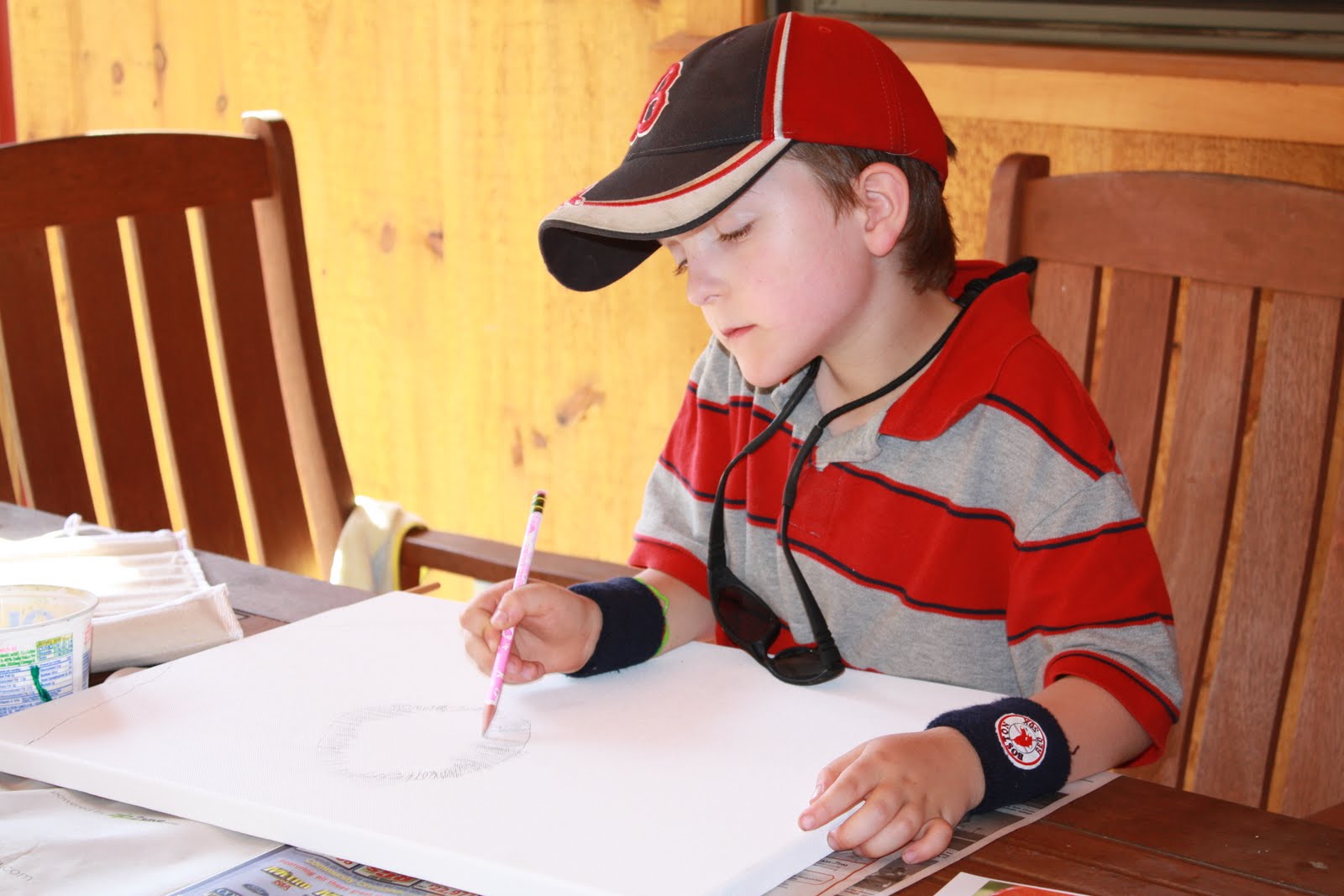
  3. Each child chose how to begin. My son preferred to draw the basic outlines with pencil first.
        My daughter wanted to launch right in with the paint.

4. I helped squirt the paint onto the tinfoil and then let them go. Here's the hard part... the best thing you can do to encourage a kid's inner artist is stay out of it. If they need help mixing colors, offer some guidance, but don't even touch those brushes to the canvas! Kids create the most wonderful, free art that captures the spirit of an object when left on their own. If they ask for help painting, tell them they're the artists and encourage them to paint their vision.

Here's what they made. Neither one looks exactly like the poppies they chose to draw, yet they are lovely, vibrant representations of the flowers my kids saw every day for about a week.


My 4 1/2 year old daughter's painting

My 8 year old son's painting

The great thing about pre-stretched canvasses is that as soon as the paint dries, you can hang them on the wall. I spent a total of  about $31.00 and have two beautiful pieces to decorate our home. Plus, the brushes can be used over and over and we still have plenty of paint for even more creations in the future. Gift idea... Father's Day is just around the corner... grandfathers and dads usually love to receive art made just for them. My husband proudly displays the canvases they made for him last year.

Would this idea work for your family or classroom? Do you have any great tips for combining a love of nature and art? Please share your thoughts.


Thursday, June 10, 2010

edible South Shore

Today I'm a guest blogger over at edible South Shore. Drop by and check it out.

Thank you to Kate Strassel for inviting me. In addition to managing the eSS blog, she's the founder of a school garden club at Central Elementary School in East Bridgewater, MA. After you visit edible South Shore, check out Kate's blog The Central School Gardeners to learn more about schoolyard gardening.

Wednesday, June 2, 2010

First Harvest

On April 11th, we planted mesclun mix and pea pods from seed. On April 29th I shared photos of our first sprouts pushing up from the soil. Yesterday, we harvested our first mesclun mix and enjoyed a lovely salad with dinner. My son, who isn't a big salad eater most of the year, devoured his. Smart boy... eating in season is the healthiest, most earth friendly way to go!

Here it is before we harvested:

We also have our first flowers on the pea pod plants, so pea pods will be here soon!


Here's a lovely head of romaine developing. I bought a "6 pack" of romaine from our local garden center and planted them about 2 1/2 weeks ago. This one will be ready in about a week.

While I was photographing the pea pod flowers, these mating dragonflies happened by. They stayed locked together like this until we went in for dinner at least 30 minutes later.


Here's a photo of our whole garden.  The raised beds measure approximately 200 square feet.

You can see, I haven't mulched with the straw, yet. Maybe tomorrow! In addition to the mesclun mix and pea pods, we also planted bush beans and pole beans from seed. Then we purchased 4-packs and 6-packs of small plants for the rest. We have 6 kale, many varieties of lettuce (roughly 24 plants), many red onions,  4 tomatoes, 6 cabbages, 6 broccoli, 4 red bell peppers, 4 green bell peppers, one zucchini, 6 parsley, 4 celery, 4 eggplant, and 9 basil inside the fence. There will be 4 jalapeno peppers, 3 basil, and 4 butternut squash outside the fence. This is risky because we have hungry bunnies and woodchucks in the area, but the garden is at maximum capacity. I've found the basil usually isn't disturbed and I expect the same will be true of the hot peppers. The squash is another story. It may become lunch for the wildlife, but I have to give it a try.

The volume of plants may seem too much to you for this relatively small space, but we've planted roughly this much each year. (The only exception is the zucchini- by the end of the summer it will take over an entire corner of the garden and overflow the walkway. I train it to grow away from the other plants and just accept that my walkway will be cut off eventually). The key to such productivity is the raised beds and excellent soil quality, thanks to awesome compost from my parents' sheep maure and our own compost bin. For more information, please read The Vegetable Gardener's Bible by Edward C. Smith. Everything you need to know is in there. Trust me!

How are your vegetables coming? Did you plant in pots, in the school yard, on a rooftop, or in a backyard garden? Please share your successes and failures.

Monday, May 31, 2010

Family Connections

Connections are important to me. Connections between people. Connections between people and nature. If we had more of both, I believe we'd have a lot fewer problems in the world. While this blog focuses on connections between kids from different cultures and kids and nature, I'd like to take a little side trip today. It may seem disconnected to you, but stick with me. I hope my comments will help you understand.

How connected are your children or students to their relatives, both dead and living? I ask this question because I believe fully understanding your family's values and beliefs enables you to make choices about continuing or rejecting those beliefs.

I am fortunate to come from a solid foundation. I grew up with my relatives nearby. When I was young, four generations lived on our farm, so I had a sense of family history.  I felt loved by my great-grandfather and great grandmother right on down to my aunts and uncles. I learned to live close to the land as I helped feed the animals, bring in the hay, and work the vegetable gardens. I learned independence romping in the woods and fields alone or building forts with my friends. I'm certain I am a naturalist because of this early beginning.

Only later, as a pre-teen, did I start to question the opinions expressed by certain relatives. I heard racial and ethnic slurs uttered on many occasions by some extended relatives. One grandfather thought women should stay home and have babies. He told my parents, "You do not waste money educating women." I didn't always like my extended family or the prejudice that existed. My questioning of that prejudice, and my parents' recognition of it, gave me the courage to grow and reach for something better. Being firmly rooted to my nuclear family and my home gave me the courage to spread my wings and fly half way around the world as an exchange student when I was just 16 years old, even when my grandfather said I belonged at home.

My parents did not want us to repeat my family's history of racism, sexism, antisemitism, etc. (you name an "-ism," it was present in my extended family). They worked hard and raised their daughters to be strong and independent. They pushed us to aim high. Each of us has studied abroad and earned Master's degrees- the first women in our family to do either.  Each of us is a strong independent woman because of our parents. Each of us views the world in a more global way than was the norm in our small home town. I am certain I am passionate about race relations and interactions between people because of the blatant prejudices I experienced as a child and my parents' critical responses to it.

The other day, as I walked in my yard photographing my beautiful flowers, all of these ideas flooded my mind. What made that happen you might ask? My strong roots, that's what. I live in the house my maternal grandparents lived in when I was a child. My parents live in my paternal grandparent's house. All around me I see evidence of my grandparents. This home is certainly ours now- we've lived here more than 15 years and made many changes to make it our own. One thing that hasn't changed is some of the gardens and plants. As I walk through my gardens, I see the flowers my grandmother planted all those years ago still blooming. Her snowdrops, crocuses, and daffodils still push up through the snow every spring. Each time I see them I think of her and smile. My front garden is a riot of color right now- some of it my grandmother's plants, some of it plants dug from friends' and relatives' gardens over the years. Gardening goes way back in my family. As I walked and photographed each of those flowers yesterday, I thought of the person who gave them to me. And there's the seed of this whole post: connections between the people in my life (some living, some dead) and nature, in the form of the plants they gave me.

For your viewing pleasure... here is a sampling of those flowers and who they're from:

My deceased grandmother's clematis. This is the first time it has bloomed for me.

My grandmother's iris. Yellow was her favorite color.

Peony dug from my uncle's garden. That ant is doing it's job--soon a full bloom!

Lupine my mom grew from seed.
Geranium dug from my great aunt's garden 10 years ago.

Iris from the original plant my mom dug from her grandmother's garden back in the 60's.

I maintain strong connections to the family that nurtures me. I embrace my family’s legacy of living close to the earth- of growing food and flowers and animals-but I reject the legacy of prejudice. I can only choose to embrace or reject something once I have recognized it, considered it, and acted in response to it.


How about you? What is your family legacy? What makes you proud? What do you want to change for your children? How will you make that happen?