When I dropped by my parent's house one day last week, my mom gave me a little present she'd been
saving for me:
Of course, I was super excited! It's a paper wasp nest that fell out of a tree in their front yard. It was damaged in a storm and abandoned by its residents (So no danger to me).
Check out the amazing patterns. I've seen many of these nests over the years but never one with such a beautiful pattern.
When I taught 4th grade, I used to bring cool items like this into my room all the time, so my mom got in the habit of saving interesting nature items she found for me. Sometimes it would be a dead dragonfly or monarch butterfly, other times a gall of some kind. The more I brought those items in, the more my students would bring them in, too. Our science table overflowed.
This one went to my son's classroom for observation.
The next time you head out in nature, see what you can find to bring back and observe. Please do not remove living things if removing them will cause them harm. For example, I've brought back a cocoon and placed it in a butterfly house for observation but I wouldn't uproot a sapling. If you catch insects, worms, slugs, etc, place them in a proper container with air holes in the top and items from their environment such as soil. After your observation, return them to their homes. And be careful to provide proper accommodations for animals that live in water or have moist skin such as salamanders and frogs.
Next Friday, I'll share a strategy that will help kids dig deeper and really investigate the items you collect.
What interesting items have you found in nature lately?
Related Posts:
Mystery Caterpillar
Mystery Caterpillar, part 2
Nature Observations With Young Children
Wednesday, November 30, 2011
Wordless Wednesday: Autumn in New England
Labels:
autumn leaves,
fall colors,
fall leaves,
nature photographs
Monday, November 28, 2011
Travel Tuesdays: Affording to Travel
My
husband and I have always known that travel would be a part of our lives, even
once we had kids. Many people wonder how we can afford it. The simple answer is
that it's important to us,
so we budget for it the way others budget for a new car or a flat screen TV. If
you live a moderately comfortable life, travel is possible for you, too, even
if you think you can't afford it. I know not everyone truly can afford to travel, but many who say they can't really can. Perhaps they can't travel to China, but they can enjoy more modest trips. And many people who take trips to Disney World with their families spend far more on their vacations than we do. It's simply a matter determining your
priorities.
We only
own one TV and it's an OLD one with a tube. Our cable plan basically provides
TV reception (you know, the cheap plan that costs about $10 per month). Our two
cars are 5 years old. We bought one new back in 2007 but we bought the other used. Our cellphones
are just phones. Not fancy phones with a data plan. Those things just aren't
important to us. But travel...now there's something we really care about.
This
isn't to say you need to forgo cable or a new car or a fancy phone. But if
you are a regular reader of this blog, you’re either interested in exploring
nature with children or learning about other cultures, so travel may be
important to you too.
If you
wish you could travel, maybe it's time to talk with your family about your
priorities. I've had many people say something like, "I wish I could take
a trip like that." So consider this...Is taking a trip important to you?
To your spouse or partner? To your kids? Often, you really can afford to plan a
trip with some changes in your spending.
I know
you've heard it all before- cut the $5.00 latte from your daily purchases, pack
a lunch instead of going out, carry a refillable water bottle instead of buying
water. The list of ways to save money is endless. But, the truth is...you see
those lists over and over again because they're true. Most of us can cut some
daily expenses if we determine we'd like to use our money for a different
purpose. The key is to decide what you want and go after it.
Once you
decide to travel, the location you choose will have a big impact on your costs.
For example, traveling to Italy in the summer will cost you a small fortune in
air fare. We had planned to go to Italy last summer but changed plans when the
budget didn’t allow it and went to Mount Desert Island in Maine. Our only real expenses were the cost of renting a cottage and gas for the drive up. Other
than that, we cooked most meals at the cottage, so we had limited meal
expenses. All of our outdoor recreation was free except for the cost of an
inexpensive park pass for Acadia National Park. We could have spent even less money if we had chosen to camp.
If this
is a topic that interests you, I highly recommend you read Alexis Grant's blog,
The Traveling Writer. She backpacked solo through Africa and blogged about the
experience. Recently she's been blogging about how to "Take a Leap"
and go after your dreams. If you dream of travel, Lexi has some great advice to
offer. While most of her recent advice is for folks wanting to take a
professional leap and become a solopreneur, her ideas work for travel, too.
(You can also search her archives for posts more specifically about travel).
Blogger Elizabeth J. Bird over
at L’appel du Vide has also been offering money saving tips for travelers
lately. And, if you’re a really adventurous traveler, check out Rolf Potts’ Vagablogging (author of Vagabonding). If you're interested in longer-term trips, he's the guy to read. You can spend less money traveling than you will living in the US for the same period of time if you're flexible and adventurous.
How have you budgeted for travel? Do you have any
money saving tips for travelers?
Related posts:
Friday, November 25, 2011
Backyard Visitors
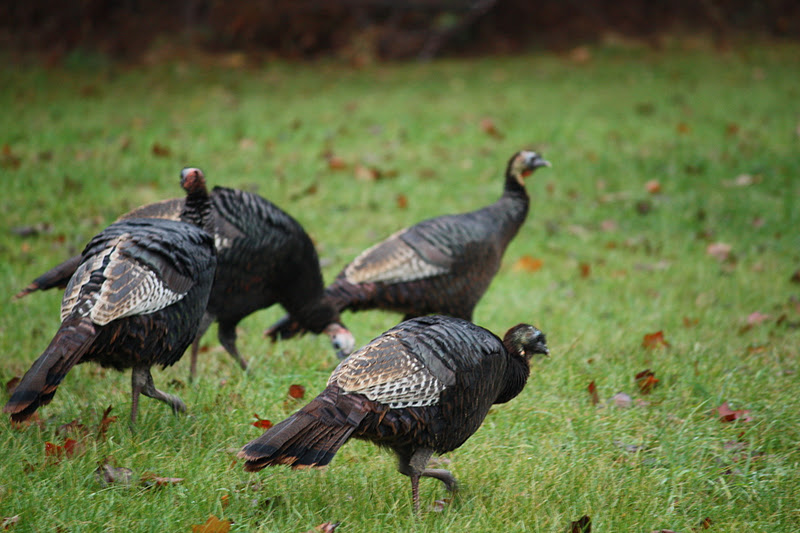
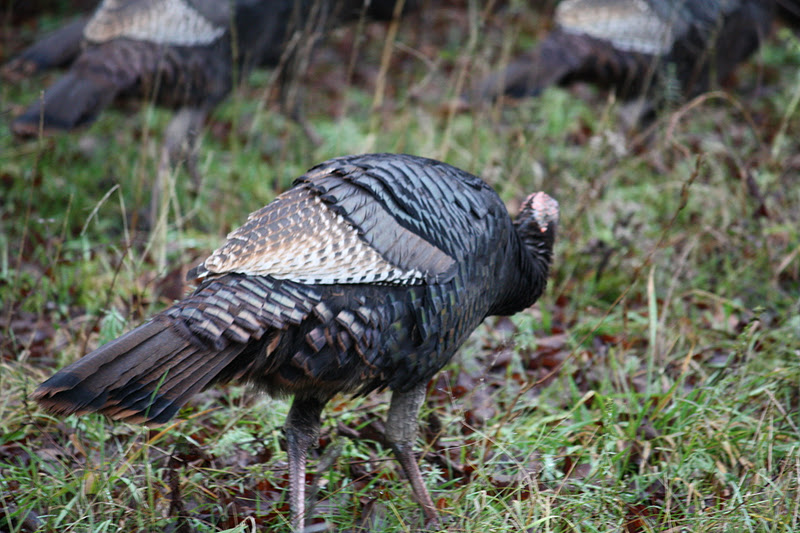
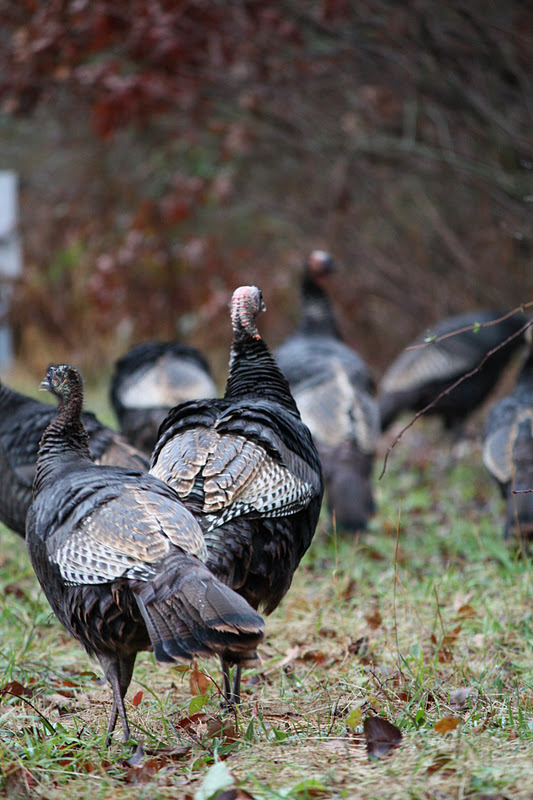
Look who wandered through our yard on Thanksgiving Eve:
I love the patterns in their feathers.
I hope all of my U.S. readers had a lovely Thanksgiving holiday, full of friendship, family, and good food.
Have you had any wild visitors in your yard lately?
Wednesday, November 23, 2011
Wordless Wednesday: Mushroom and Lichen and Moss, Oh My!
Photos taken 13 November 2011
Which photo do you prefer?
Related Posts:
Monday, November 21, 2011
Travel Tuesdays: Holiday Travel
In an earlier post, I encouraged you to pack your sense of humor when you travel. Today, as we enter the holiday season, I also encourage you to pack patience as you set out to visit friends and relatives. If you'll serve as host/hostess, be sure to dig yours out, as well.
Of course, patience isn't a thing you can literally put in your suitcase. But as you pack your bags, you can take a minute to consider the virtues that will make your holidays more enjoyable. The holiday season can be a wonderful, joyous time of year. It can also be incredibly stressful. Perhaps you try to squeeze too many activities into too little time. Or maybe you squeeze too many people, related or not, into a small space. Or you set too high expectations about what the perfect meal or party should be...the variety of stresses I could list is endless. You know what they are for you and your family. Plan for them so you can get on with the important business of enjoying your family and friends.
Once you pack the clothes, shoes, presents, and toiletries, take some time to mentally prepare for the stresses you'll face. Then toss your sense of humor and your patience in your suitcase and go have a good time.
Do you celebrate a holiday in November or December? What holiday? What will your celebration be like?
Friday, November 18, 2011
The Holiday Season
Several weeks ago, a photo that juxtaposed two images popped up on Facebook. The left was a photo of (I assume) a "starving African child" lying on the ground wearing only a tattered shirt. The right was a Christmas tree with a huge pile of presents spewing out from underneath it. While I am uncomfortable with the exploitative nature of the child's photo, I appreciate the underlying message.
Before you rush out to buy your children every toy in the world, and perhaps rack up thousands of dollars on your credit card, think about ways you might make your gift-giving more meaningful, personal, or charitable. Whether for Christmas, Hanukkah, birthdays, or other celebrations, is spending thousand of dollars on more "stuff" necessary? When our friends visited from India they commented on how much "stuff" Americans have. We have relatives who live in the UK and they've told us the same thing.
This holiday season, I encourage you to slow down. Enjoy your family and friends. Instead of spending an entire day out shopping, dedicate that time to making simple gifts for friends and family. Bake cookies and give those as gifts. Provide a variety of papers, glue sticks, scissors, stickers, etc. and have your kids make cards. Provide paints and paintbrushes and have them paint pictures for their relatives. Buy simple frames at a craft store or discount store to display them. If you're interested in more specific craft ideas, there are LOADS of resources in your local library and on the Internet that offer simple, inexpensive gifts you and your children can make.
Another way to make the season more meaningful is donate money in someone's name. There are so many ways to give back. Here are two of our favorites:
1. Heifer International focuses on raising people around the world (including the US) out of hunger and poverty by helping them become self-sufficient. They provide animals appropriate to the region in which a family lives and teach them how to keep the animals healthy and productive. When the animal has babies, the family "passes on the gift" by giving the offspring to others in their village. Heifer provides lovely gift cards that announce your gift, or you can have an email sent to the recipient.
To teach your children about the benefits of such a donation, read them Beatrice's Goat by Page McBrier. (If you purchase the book, a percentage of the proceeds go to Heifer). Beatrice's life in Uganda improved dramatically after her family received a goat from Heifer. I was lucky to have Beatrice visit my classroom in 2001. She was an intelligent, lovely, 16 year old. She spoke several languages and shared her story with my students in English. They were so moved, they began a fundraiser for Heifer. We have been regular supporters of the organization ever since.
2. Support a family in need in your community. We donate to a locally run organization that helps families in our area. Nearly every town has an non-profit organization or church group that supports families in need. Many school nurses also know of families in need and can arrange for anonymous donations to help those families. Many retail establishments also have tags listing needed items. You can choose a tag, make a purchase and deliver it to that store.
Related to this point, our children receive an allowance every week. To "store" their allowance, they have three jars. One is labelled "Save," one "Donate," and one "Spend." We've told them a minimum amount they need to put in the "Save" jar (to go in the bank). Otherwise they divide their money as they see fit. Then they choose how to donate the money they save. Last year, both kids decided to use the money to buy a toy for a child in need. We went out as a family and made our purchases, then we delivered them to the organization that ensures anonymous donations.
If you look closely at the two ways my family supports others in need, you'll see they match what is important to us. That is not to say other organizations are not important. Of course they are. But one family can only donate so much. Find what you are passionate about and choose an organization that supports those passions.
One final note: If you find your family in tough financial times this year, don't be afraid to reach out for help. There is no shame in asking your community to support you in your time of need. Some day in the future, when you get back on your feet, you can "pass on the gift" by helping someone else.
Have you benefited from the generosity of others? What are your favorite charitable organizations? (Please include links, when possible, so others can learn about them. Note: charitable organizations only, please).
Before you rush out to buy your children every toy in the world, and perhaps rack up thousands of dollars on your credit card, think about ways you might make your gift-giving more meaningful, personal, or charitable. Whether for Christmas, Hanukkah, birthdays, or other celebrations, is spending thousand of dollars on more "stuff" necessary? When our friends visited from India they commented on how much "stuff" Americans have. We have relatives who live in the UK and they've told us the same thing.
This holiday season, I encourage you to slow down. Enjoy your family and friends. Instead of spending an entire day out shopping, dedicate that time to making simple gifts for friends and family. Bake cookies and give those as gifts. Provide a variety of papers, glue sticks, scissors, stickers, etc. and have your kids make cards. Provide paints and paintbrushes and have them paint pictures for their relatives. Buy simple frames at a craft store or discount store to display them. If you're interested in more specific craft ideas, there are LOADS of resources in your local library and on the Internet that offer simple, inexpensive gifts you and your children can make.
Another way to make the season more meaningful is donate money in someone's name. There are so many ways to give back. Here are two of our favorites:
1. Heifer International focuses on raising people around the world (including the US) out of hunger and poverty by helping them become self-sufficient. They provide animals appropriate to the region in which a family lives and teach them how to keep the animals healthy and productive. When the animal has babies, the family "passes on the gift" by giving the offspring to others in their village. Heifer provides lovely gift cards that announce your gift, or you can have an email sent to the recipient.
To teach your children about the benefits of such a donation, read them Beatrice's Goat by Page McBrier. (If you purchase the book, a percentage of the proceeds go to Heifer). Beatrice's life in Uganda improved dramatically after her family received a goat from Heifer. I was lucky to have Beatrice visit my classroom in 2001. She was an intelligent, lovely, 16 year old. She spoke several languages and shared her story with my students in English. They were so moved, they began a fundraiser for Heifer. We have been regular supporters of the organization ever since.
2. Support a family in need in your community. We donate to a locally run organization that helps families in our area. Nearly every town has an non-profit organization or church group that supports families in need. Many school nurses also know of families in need and can arrange for anonymous donations to help those families. Many retail establishments also have tags listing needed items. You can choose a tag, make a purchase and deliver it to that store.
Related to this point, our children receive an allowance every week. To "store" their allowance, they have three jars. One is labelled "Save," one "Donate," and one "Spend." We've told them a minimum amount they need to put in the "Save" jar (to go in the bank). Otherwise they divide their money as they see fit. Then they choose how to donate the money they save. Last year, both kids decided to use the money to buy a toy for a child in need. We went out as a family and made our purchases, then we delivered them to the organization that ensures anonymous donations.
If you look closely at the two ways my family supports others in need, you'll see they match what is important to us. That is not to say other organizations are not important. Of course they are. But one family can only donate so much. Find what you are passionate about and choose an organization that supports those passions.
One final note: If you find your family in tough financial times this year, don't be afraid to reach out for help. There is no shame in asking your community to support you in your time of need. Some day in the future, when you get back on your feet, you can "pass on the gift" by helping someone else.
Labels:
Beatrice's Goat,
charitable donations,
Christmas gifts,
Hanukkah gifts,
Heifer International,
holiday gifts
Subscribe to:
Posts (Atom)