Showing posts with label poison ivy. Show all posts

Tuesday, October 15, 2013

Poison Ivy Identification #2

I've noticed an up-tick in the number of people visiting my post, Poison Ivy Identification. Written in the month of May, it provides descriptions and photos to help readers identify poison ivy. (Please hop over and read it to learn more). Now that we're into the month of October, that poison ivy looks very different, so I thought fresh photos might help you learn to identify it in the fall.

What follows is a collection of photos I took on October 11th.

Here's a typical example of Poison Ivy growing along the ground.

As it climbs a tree it may look like this:


Or this. Note that in this case, it climbed more than 20 feet in the air. All of the bright leaves you see are poison ivy.

Here's a close-up of the leaves:

And here are the berries. Yes, berries.  (Do not touch them either!) 


And here's what the vines look like when climbing the trees. Those little hairy bits help me identify it in the winter when there are no leaves. When I was a kid, I learned the hard way...you can get poison ivy in the winter from touching the vines.


If you live where poison ivy grows, learning to identify it is an important skill. Some people are lucky not to "catch" it but most of us are not so lucky. The rash is, at best, an annoyance, and at worst dangerous enough to warrant being put on steroids by a doctor. It's best to learn to avoid it altogether.

Do you have any tips for identifying/ avoiding poison ivy? Are there other plants you need to avoid where you live?

Related posts:


Friday, May 24, 2013

Poison Ivy Identification


Note: A different version of this post originally ran on May 18, 2010. Several people have recently told me they don't know how to identify poison ivy, so I thought rerunning this might be useful.

I'm super allergic to poison ivy (sometimes I swear I get it just by looking at it) so I taught myself how to identify it in every season.

Today, I offer these photos to help my New England readers avoid poison ivy. This is what poison ivy looks like now. 

Notice the differences in the color and size of the leaves. Poison Ivy can look very different even in the same area.  All of these photos were taken within roughly 1/4 mile of my house.

One thing that is consistent is the presence of three leaves in a cluster. Usually those leaves are shiny. Sometimes those leaves are mostly green.


Other times the leaves are more red. (Especially when they are first sprouting in the spring).

Sometimes it grows low to the ground like in the photos above. Other times it climbs up posts, signs, and trees as in these photos:

This one is about 3 feet tall.

                                                       
This one climbs about 20 feet into the tree.

These last two photos are NOT poison ivy. This vine is sometimes confused with Poison ivy because it climbs the same way and has similar shaped leaves.
But look closely... there are 5 leaves in each cluster and the leaves are more jagged.


One final tip: poison ivy thrives along the edges. That is, in the area where one ecosystem transitions to another. For example, some of these photos were taken along the edge of a field where it transitions into forest (in partial to full sun), others along the edge of a brook (in partial sun), still others along the edge of a road (in full shade). Also watch for it along the edges of parks, paths, or trails.

Do you know how to identify Poison Ivy? Do you have any other tips?

Related Posts:

Tuesday, May 18, 2010

Mystery Rash

One winter, when I was in the 5th grade, I came down with a mysterious rash on my face. It was blotchy, blistery, and itchy. My mom, a trained nurse, couldn't figure out what it was, nor by extension, how to help me. She theorized that maybe I had sat too close to the wood stove and burned my face (I do love a hot fire in the winter months). She wondered if I'd had an allergic reaction to the laundry detergent or perhaps the soap I used to wash my face. She applied cool compresses. She tried various itch creams. Nothing helped. Finally, she took me to the doctor who eventually determined I had poison ivy. In the dead of winter. How could that happen? No-one knew until a couple of weeks later when I brought home a school project.

We were studying the native people from our area- Wampanoags- and I had built a scale model of what we then called a wigwam, though I now know the proper term is wetu. And what, you ask, did I use to lash the poles together? You guessed it- poison ivy vines. Who knew you could get poison ivy from those? Who even knew what they looked like? That day, I vowed to learn what poison ivy looked like in every season so I wouldn't catch it again. Sadly, I have caught poison ivy since, even as an adult, (sometimes I swear I get it just by looking at it, I'm that allergic) but I do know exactly what it looks like, no matter the season.

Today, I offer these photos to help my New England readers avoid poison ivy. These were all taken in the last week, so this is what poison ivy looks like now. I'll be sure to post some photos during the fall and winter to help you avoid my itchy mistake!
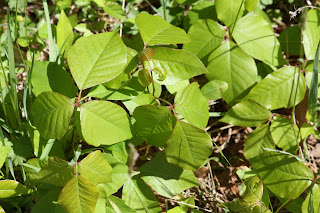
Notice the differences in the color and size of the leaves. Poison Ivy can look very different even in the same area.  All of these photos were taken within roughly 1/4 mile of my house.

One thing that is consistent is the presence of three leaves in a cluster. Usually those leaves are shiny. Sometimes those leaves are mostly green.

Other times the leaves are more red. (Especially when they are first coming out in the spring).
Sometimes it grows low to the ground like in the photos above. Other times it climbs up posts, signs, and trees as in these photos:

This one is about 3 feet tall.
                                                       
This one climbs about 20 feet into the tree.

These last two photos are NOT poison ivy. This vine is sometimes confused with Poison ivy because it climbs the same way and has similar shaped leaves.
But look closely... there are 5 leaves in each cluster and the leaves are more jagged.

One final tip: poison ivy thrives along the edges. That is, in the area where one ecosystem transitions to another. For example, some of these photos were taken along the edge of a field where it transitions into forest (in partial to full sun), others along the edge of a brook (in partial sun), still others along the edge of a road (in full shade). Also watch for it along the edges of parks, paths, or trails.